Saturday, December 2, 2017

The Cambodian Genocide


Warning: this is graphic stuff. But an important story to share.

From 1975 to 1979, 1.5-2 million people were killed by the Khmer Rouge in Cambodia - 25% of the country's population. The goal of the Khmer Rouge, led by Pol Pot, was to turn the country into a classless "utopia". They emptied out the city of Phnom Penh and sent everybody into the countryside to be farmers. Anybody who was too educated, anybody who resisted, anybody who had the same name as somebody who was educated - and all of their family members along with them, including children - were sent to prison and killed.

There is a lot of history behind this and I don't want to overburden this blog with the information, so please feel free to read more about the genocide here: http://endgenocide.org/learn/past-genocides/the-cambodian-genocide/

As I said in an earlier blog, there is no Cambodian who was not affected by this genocide. Our guide on this day, Sarik, lost two siblings during that 4-year period due to starvation and his uncle was murdered because he had the same name as somebody the Khmer Rouge was looking for. They later apologized, after they killed him and realized he was not the right person.

While staying in Phnom Penh, we visited Choeung Ek - one of the "killing fields", and a prison. Living in Germany, we have been to a number of holocaust museums and concentration camps. You'd think we've seen as bad as it can get and nothing could shock us at this point. But, there's this tree in Choeung Ek. They beat babies against it until they died. They didn't use guns to kill people here because guns were expensive and hard to come by, so they had to improvise and many deaths were slow and every single murder, even the babies, was personally and deliberately carried out by Khmer Rouge members one at a time. Here is the tree, you can read the sign next to it. Many visitors leave their Buddhist blessing wristbands on this tree in hopes to bring the babies some peace.


The killing fields are fields filled with mass graves. Bones are everywhere and they come up especially when it rains. Every depression seen in the pictures below is a mass grave filled with hundreds of bodies. Note most have been exhumed but many bones remain.


And signs warning visitors:


This is the tree where they hung loudspeakers to play music so people in the area wouldn't hear the screams and moans of the dying.


Our guide holding up one of the weapons used to kill people - a palm frond. The Khmer Rouge used anything and everything as weapons. Mostly, they killed people by hitting them with a hoe or iron ox cart axle in the head, pushing them into a mass grave, and then cutting open their throats and chests and covering them with DDT to ensure they'd all die. There are also trees with poisonous fruit here and some people were told they were being brought someplace new to restart their lives, then they were fed this fruit thinking they were being fed and treated well but it killed them.


9,000 skulls have been saved in a memorial in the center of the site. Many are fractured.


After the killing fields, we drove back to Phnom Penh and visited the S-21 prison where people were kept before being taken to the killing fields. It used to be a school and was converted to a prison. Here people were starved and tortured until they gave up somebody else's name, then they were allowed to be killed.


Some cells where prisoners were kept:


Barbed wire everywhere so people couldn't jump from upper floors and commit suicide.


There were a few child survivors of this camp when the prison was found by Vietnamese soldiers in 1979. One of them is at the prison site and you can speak with him. Most of the survivors have written books telling their stories that you can buy.

Amazingly, the Khmer Rouge were never made to pay for their crimes. The Cambodian people simply let them run off or continue living in the country - some even went on to become members of the country's government! Our guide told us that they believe in karma and that members of the Khmer Rouge will get what they deserve at some point. Even Pol Pot himself died of heart failure in 1998, never imprisoned or made to pay for his crimes.

Friday, December 1, 2017

Cambodia: Street Food


We drove from Siem Reap (well, our driver did) to Phnom Penh where we went right into a street food tour. We were picked up by our tuk-tuk and headed out to our first stop at the FCC (foreign correspondent's club) for a cocktail and view over the Mekong river. In the rain, unfortunately, but you get the idea.


The top floor of the FCC:


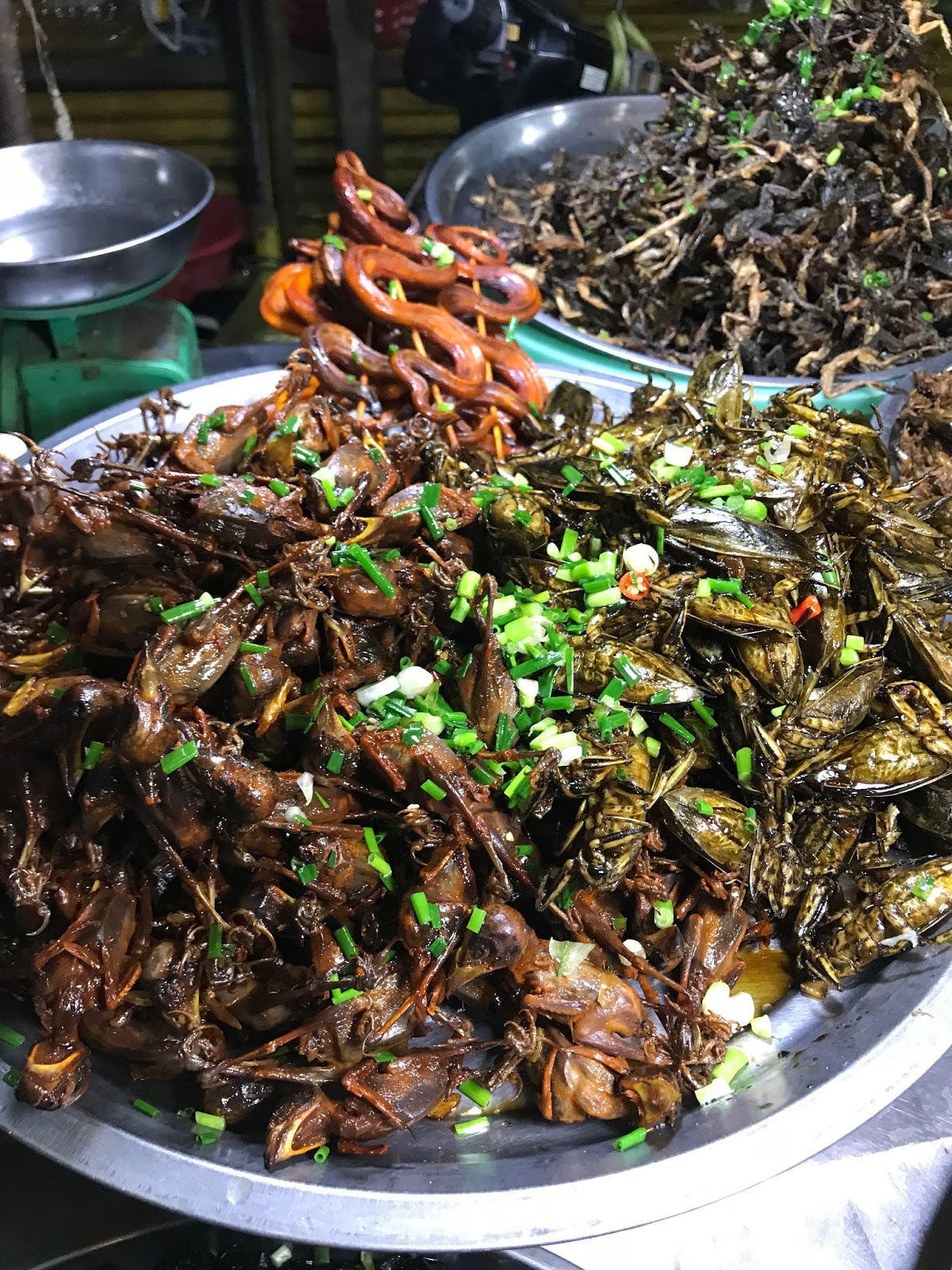
Our next stop was ... insects. :| Neither one of us was a fan of trying any of them, however, Martin was talked into trying a cricket and a frog and I tried some snake. It took some convincing from our guide. Cambodians do actually eat all of these bugs - they snack on them while watching TV like Americans snack on chips or nuts. A ton of locals came up to this cart and bought bugs while we stood around trying to find the courage to eat just one thing. They have friend tarantulas too! No pictures of those, I had my eyes closed.


You have to peel the skin off the snake to eat it because the inside is filled with bones you don't want to eat. It's a good thing we had a guide helping us with this because I probably would have just tried to take a bite out of the whole thing.  Video below.


After trying some insects, we hit up the fruit/veg night market.  This was a narrow street lined with stalls selling all kinds of fruit and vegetables.  Cambodians like to eat everything as fresh as possible, so they buy fruit/veg every single day - only enough to get them through that day.  At this market we bought some jackfruit and some dragonfruit.  I really enjoy jackfruit but I think I ate too much of it this night so I didn't touch it again for the rest of the trip even though I really wanted to.


Here I am, helping our guide Sarik pick out the dragonfruit.


Here the woman is packaging up some jackfruit for us.  Jackfruit is the biggest tree-borne fruit in the world, the internet tells me.


After getting our fruit, we wandered into another little market selling, well, street food. Here we enjoyed some bbq'd meat skewers with pickled vegetables. Combining the meat with the pickled veg is genius - it was delicious. Sorry no picture of everything together; I ate it too quickly.


Then we got a big yellow pancake. It was filled with bean sprouts, ground pork, and a few other things. You eat it with lettuce and it's also delicious.


This is what the little market selling small meals looked like. Not much, lined with scooters. But filled with so much good food.


Our final stop was a seafood place. It's kind of a hot mess from the outside - crowded, small, super busy and hot. Pic below.


You basically order any seafood you want, they grill it, and then bring it to your table. We got curried crab, tom yum soup, and a half of some sort of white fish. It was all delicious.


Our guide Sarik also bought us some weird coconut-rice pudding super solid thing for dessert. He ate it with gusto but we couldn't get excited about it. It was solid and was kind of like eating the solid part of coconut milk when it's really hard.


Here's a close-up of the dragonfruit. There is also white dragonfruit - don't eat it it's not appetizing. The purple is better than the white but still not my favorite fruit. At least it's edible though - the white stuff really tastes like almost nothing. And it's so pretty!


Sarik, thinking our stomachs bottomless, also bought a lotus flower and had us eat some of the seeds. They didn't really taste like anything but they're eaten in desserts, stir fries, and used for tea.


Yes, my stomach rebelled later that evening. Martin's didn't though, and my discomfort only lasted a few hours. I have no regrets, all the food was amazing and every single thing I ate was a new experience that I'd hate to have missed out on.

Cambodia: Village Tour


On our second day in Siem Reap we went to tour the village of Krabei Real and have lunch in the home of a family there. The village is located about 15 minutes outside of Siem Reap. We started the morning at the village market, which was very small and consisted of a handful of stalls where everybody from the village brought their produce to sell to the rest of the village. Here we were met by our host and his 14-year-old daughter (who was bravely working on improving her English).


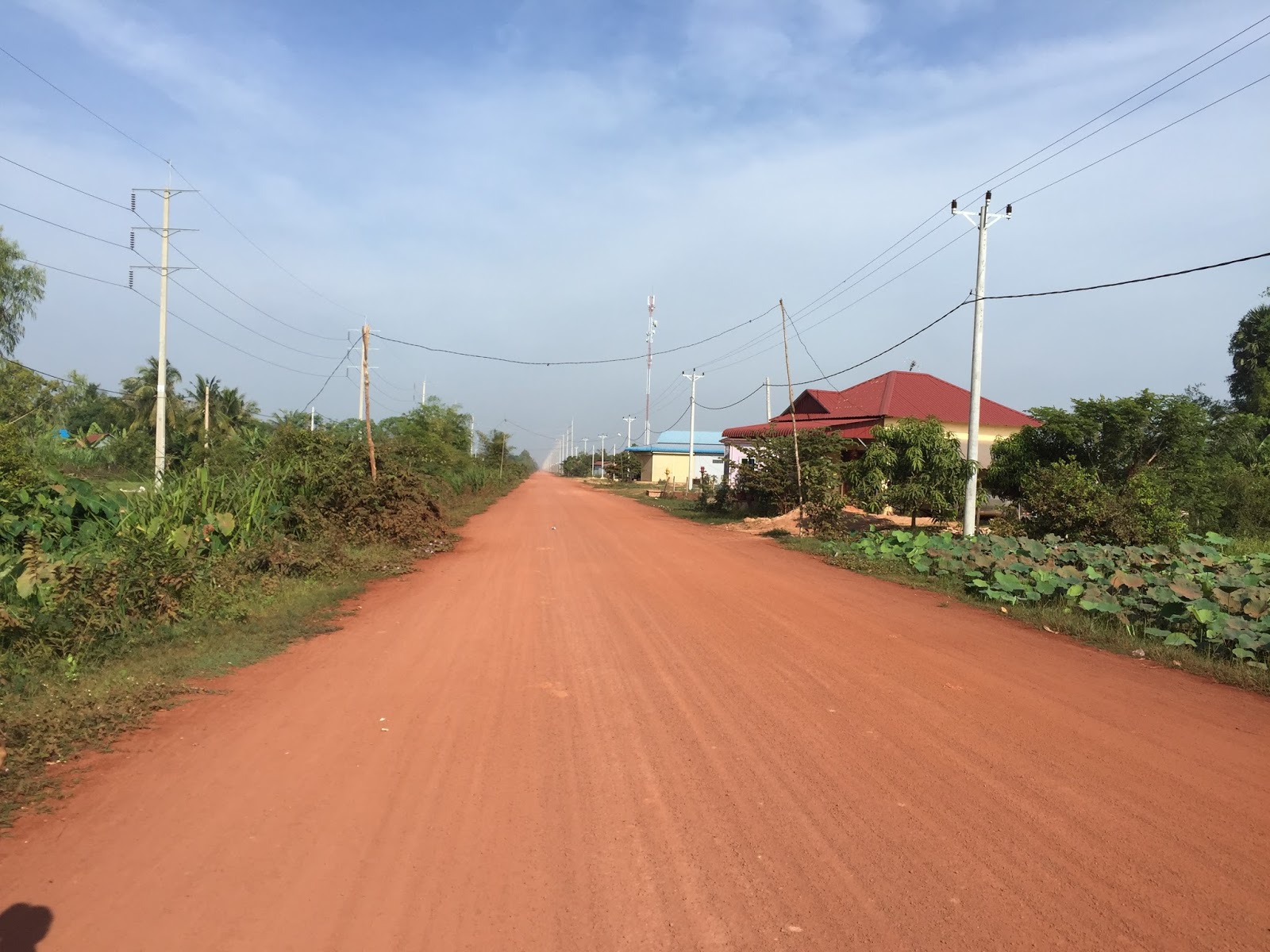
After buying the meat and veg, we walked down dirt roads, dirt paths, and finally a paved road, to the house of our hosts where we would be eating lunch. Now I enjoyed this walk - we learned a lot about village life while on it, but MAN was it hot and humid!


We saw lots of water buffalo - they hang out in the water to stay cool. Smart.


We saw several people, and in the pictures below a mother and her sons, fishing to catch food to eat that day. This is how many people in this village obtain their food.


We stopped by the home of some people who were rattan weavers (sorry no picture of the weaving) where we bought a few of their products for about $1 each (yes they use USD in Cambodia - a nice surprise for me). Okay I didn't get a picture of the women weaving but I got a picture of their pigs. They were really cute. I try not to think about the fact that they're raised to be eaten.


The weaver family also made rice wine. Most Cambodians are rice farmers and so, naturally, some of them find something interesting to do with the rice. This is also why they have pigs - making rice wine creates a lot of waste that's good feed for pigs. This was the rice wine making setup in their backyard.


And then we still had about another 30 minutes of walking. I almost died. The pic below is our guide, our host's 14-year-old daughter, and myself, walking through the warmest, sunniest, stillest area on earth. ;) Even the daughter said it was really hot! Note the usual method for this tour is via ox cart and not by foot, however I don't like riding in ox carts while the oxen are constantly whipped, so we opted to walk. Also, riding in ox carts is very bumpy, rough, and painful.


Lots of cows too. There are no milk cows in Cambodia - all milk is imported. Cows here are used for meat or for pulling carts.


Finally, we arrived at the home of our hosts. Here we learned many interesting things about Cambodian culture and life. For starters, there were 4 generations living in this home. When Cambodians get married, they move into the home of the *woman's* family. So the four generations in the house were based on the women - a grandmother, her daughter with her husband, their 2 daughters, and one granddaughter. They get married when they're around 18 - arranged marriages - so it's easy for so many generations to be around at once.

The women stay home and do all the cooking and cleaning here - so in the pictures below you can see the eldest daughter doing all the cooking. She made us a pork dish, a chicken dish, and a soup. And tons of rice - Cambodians eat rice three meals a day, and sometimes it's just plain white rice as they often don't have money to have anything in addition to it besides maybe some fruit.


Cambodians also eat on the floor, family style. It was kind of nice, though people who aren't very flexible will have a tough time sitting cross-legged for a meal. Below are pictures of the lunch spread. In the third picture below, the man on the left was our driver (we really loved him) and the guy on the right was one of our hosts.


Dessert was fresh fruit - watermelon, bananas, and the weird fruit below. I don't remember the name of it but it was pretty good!


After lunch we chatted a bit and we learned that the mother was the grandmother's only child because the grandfather was killed during the Pol Pot regime's genocide.  This led to a lot of storytelling from each person of their personal experience during the genocide.  As our guidebook said, you won't find a single person in Cambodia who was not affected by the genocide.  Everybody lost at least one relative, has stories of walking by dead bodies, hiding in fields, etc, and they all share them very openly so that the world won't forget.  I will write a separate blog about the genocide.

Below is a picture of our host's house. All houses in Cambodia are built on stilts, or are built at least so that there is nothing on the bottom floor and it is open-air in case of flooding. They all have a staircase going directly into the second floor of the house. Not all areas of Cambodia flood, but everybody seems to build their houses this way, "just in case".  I think our host's house is the most closed-off house I saw in Cambodia, however the bottom floor was completely empty so it still had the idea of having an empty bottom floor.


Here is a video I took during our drive out of Siem Reap the following day - you can see (sorry it's kind of fast) how all the houses are on stilts.  There is almost no exception to this rule.  Additionally, underneath the houses is where the family hangs out, stays cool, eats their meals, naps in hammocks in the afternoon, etc.  This is where daily life happens.


If you're ever in Cambodia and have the opportunity, don't hesitate to have lunch with a local family.  I learned so much from it, and the food was amazing too.  However if you do go, make sure you accept the second offering of rice!  I turned it down and never heard the end of it from the mother about how little I ate (the first helping of rice was a good portion too!  I wasn't really slacking!).